Six wall panels in the house listen for one word, “Majordome”, French for butler. Say it, ask something, and an answer comes back in French a second or two later. Nothing goes through a voice cloud: the wake word, the speech recognition, the language model and the voice all run on machines in the house. Only a few tools reach the internet: web search, directions, weather and streaming music.
I described the panels themselves in the NSPanel post. This one is about the voice chain, and mostly about the part that took longest: deciding whether the house really heard its name.
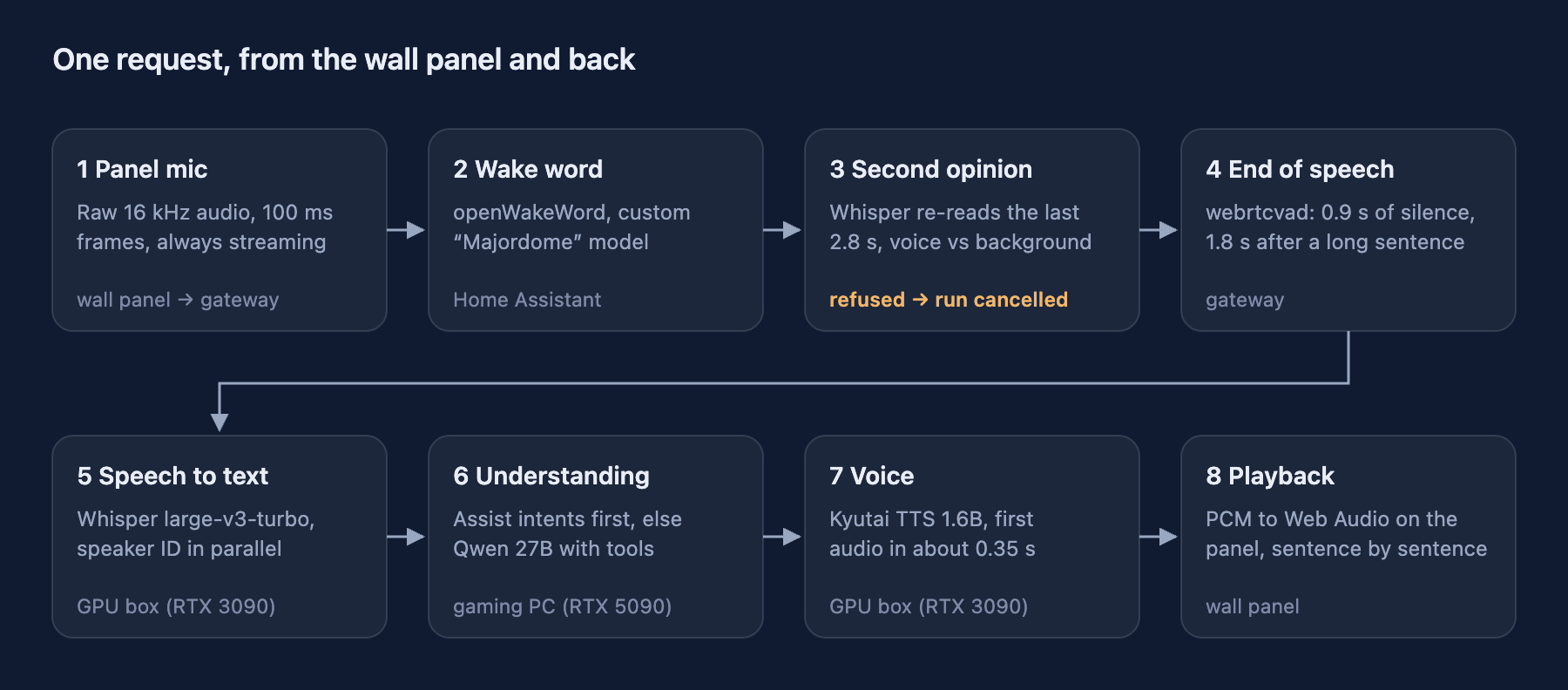
One request from start to finish. The panel only streams its mic and plays audio back; everything else runs on a small gateway, in Home Assistant, and on two GPUs.
The chain, quickly
- Mic. Each panel streams raw 16 kHz audio in 100 ms frames over a WebSocket to a gateway I wrote, all the time. The panel doesn’t detect anything itself.
- Wake word. The gateway feeds that audio into a Home Assistant Assist pipeline, which runs openWakeWord with a model I trained for “Majordome”.
- Second opinion. When the detector fires, the gateway sends the last 2.8 seconds to Whisper and compares the voice level with the background. More on that below.
- End of speech. The gateway decides when I’ve stopped talking, with webrtcvad: 0.9 s of silence, or 1.8 s once I’ve spoken for two seconds or more, 30 s at most.
- Speech to text. Whisper large-v3-turbo on an RTX 3090, in French, with a hint listing the room names. A speaker-identification model (TitaNet) runs at the same time, so the agent knows who is asking.
- Understanding. Home Assistant’s own intents get the first try, so “turn on the kitchen light” never touches a language model. Anything else goes to Qwen 27B on the RTX 5090 in my gaming PC, or to a lighter model when that PC is asleep.
- Voice. Kyutai TTS 1.6B with a custom butler voice, on the same 3090 as Whisper. The first audio is ready in about 0.35 s, and the panel plays it as raw PCM through Web Audio, one sentence at a time.
After an answer the panel keeps listening for about six seconds, so a follow-up doesn’t need the wake word.
“Hey Jarvis” didn’t speak French
I started with openWakeWord’s stock “Hey Jarvis” model. It was trained on English pronunciations, and with a French accent it barely fired. I tested it with French synthetic voices: at the default threshold of 0.5 it never triggered, and it only became reliable around 0.1 to 0.15.
At 0.1 it was a disaster. Eleven false wakes in about five minutes, and it answered conversations nobody had addressed to it. Lowering the threshold was clearly not the fix.
So I added a second opinion in the gateway. On every wake it sends the last few seconds to Whisper and only accepts if the text reads back as the wake word. That stopped the false wakes, and it showed how often the detector was firing: 761 times in 23 hours, 9 of them real. With “Jarvis” given as a hint, Whisper turned plain noise into “Alex.” 552 times. One evening a burst of wakes on every panel read back as “Alex.”, “Benjamin.”, “Bye. Bye. Bye.” and “Hej Jörbiz”, very likely someone at home trying to call it with a French accent. All refused.
A word of its own
The real fix was a different word. I wanted one French word with clear consonants that rarely comes up on TV or in conversation, and “Majordome” won.
There is no off-the-shelf model for it, so I trained one with openWakeWord’s training pipeline on the GPU box: about 9,800 synthetic positive clips from French voices and speakers with French phonemes, and 14,000 adversarial negatives, words and phrases that sound close. On held-out clips it caught 97 to 100 % of clean samples, but only 40 to 55 % once noise and reverb were added. On validation audio, mostly English, it produced about one false wake an hour at a threshold of 0.8.
That’s the detector. In a real house, with a TV, music and people talking, it still fires far more often than that, which is why the second opinion stayed.
Two bugs that changed how I think about “no”
An empty answer counted as a yes. One rule accepted a re-read of one or two words, so a short French word like “Majordome” said quickly would pass. It also accepted zero words. Overnight that let through 263 false wakes, and the bedroom panel answered film dialogue out loud. Now an empty re-read is a refusal.
A refused wake still ran. When the gateway refused a wake it closed the audio stream, but Home Assistant then finished the request with whatever it had heard. One morning the office panel picked up “C’est parti” (“here we go”), Home Assistant matched it to cinema mode, and the bedroom screen came down. Now a refusal cancels the whole pipeline run, so nothing behind it executes.
Both came down to the same lesson. A refusal has to stop the request completely, and an empty result is not a match.
What the numbers say
Every wake, accepted or refused, is saved as a short clip with what Whisper read back, so I can count.
Before tightening the rule, 6 to 13 November. 981 wakes refused and 25 accepted. Only one of the 25 read back as “Majordome”. The rest got through on the voice-to-background ratio, and most ended with an empty transcript or the agent deciding it wasn’t a request. At least three still produced speech, like a note confirmed out loud at 22:39. I haven’t checked whether those three were real requests.
After tightening, 14 to 24 November. The rule now accepts a wake if Whisper reads “Majordome” back, if the re-read starts with “Bonjour” and the voice is clearly above the background, or if it’s one or two words with a very strong voice level. On the six panels: 1,241 refused, 18 accepted. Eleven of the 18 read back as the word or something close (“Ma Jordan”, “Moi, Jordan”, “C’est un majordome”). The other seven were things like “Okay.”, “Ah” and “Three. Yeah.”
The entry hall refuses the most (436). The living room, where the TV is, and the bedroom follow with 252 each, then the upstairs hallway with 194.
What I can’t tell you is how many real calls it misses. The refused clips are all saved, but I haven’t listened through 1,241 of them.
Knowing when I’ve finished
The other half of feeling fast is ending the recording at the right moment. The gateway runs webrtcvad on 20 ms slices and also checks the level against the background.
In November the office panel was slow to react to “open the curtain”. The recording showed why: after “Majordome”, the room stayed above the gate for seconds, at 200 to 450 against a voice peak of about 5,000, and the gateway counted that as speech. It kept listening for more than 8 seconds. Now the gate also uses 10 % of the wake word’s own peak. Replayed on the saved recordings, that request went from 8.6 s to 3.9 s, and normal sentences didn’t change.
Counted end to end, from my last word to the first sound, it’s at least about 1.4 s even in the best case: 0.9 s of silence, then transcription, then the first audio. The four real requests I measured carefully took 1.7 to 6.3 s, all of them answered by the language model.
What the language model is allowed to do
The agent is Home Assistant’s conversation agent pointed at a local Qwen through a small relay. Its tools come from Home Assistant and from MCP servers on the LAN: web search through SearXNG, directions, reminders, announcements on other panels, weather, a look at a camera, and music.
What it can switch is decided by which entities I expose to Assist, not by the prompt. The prompt does have a section on what it must not do by voice, but the hard limit is exposure. If the text isn’t a request, from the TV for example, the agent answers exactly IGNORE and nothing is said. If that happens within nine seconds of the wake word, the panel listens again, because it often means the first words got clipped.
Answers are capped at 250 tokens, and the conversation is forgotten after two minutes. The volume drops at night.
What still needs looking after
- One box for ears and voice. Whisper, the speaker model and the voice all run on the same GPU VM. If it goes down, the assistant is deaf and mute, and there is no fallback. Worse, the second opinion fails open when Whisper doesn’t answer, so false wakes go up at the same time.
- The gateway is a single process. If it stops, all six panels lose voice.
- It can hear itself. Once, an answer failed halfway, the fallback sentence (“Sorry, can you rephrase?”) played, and the panel probably heard that sentence and answered it. The mic now stays muted until the last sentence has played. That logic is in place, but I haven’t tested it by voice yet.
- Missed wakes aren’t measured. See above.
- Everything is recorded. Every request and every wake clip is kept locally, more than a thousand of them by now. That’s how I could write the numbers in this post. It also means a mic streaming all day in every room with a panel. Nothing leaves the house, but it’s worth being honest about.
What’s public and what’s mine
The pieces are public: openWakeWord, faster-whisper, webrtcvad, Kyutai TTS, Qwen, SearXNG and Home Assistant’s Assist. The gateway, the “Majordome” model and the panel pages are mine, and so far I haven’t published them. The gateway is full of my rooms and devices.
If you’re building something similar in a language that isn’t English, I’d be happy to compare notes in the comments, especially on wake words.
Comments
Loading comments…